Tuesday, January 19, 2010

The Red Badge of Courage


Stephen Crane's The Red Badge of Courage amazed me with the main character's tale of bravery in the face of death.
In The Red Badge of Courage the youth (as he's called throughout the story) leaves home to fight in the army during the American Civil War. This in itself is the youth taking a stand against his mother, who wanted nothing to do with the War. I believe that the youth might have felt a little bit obligated to serve. However, this idea is mostly thrown off when the youth confesses to himself that he joined for the wrong reasons. Those reasons being that he wanted more so to defy his mother. The youth also joined because he saw, or rather imagined, himself as being a hero among the soldiers by using courageous speeches and battlefield survival. Another stand is taken by the youth when he and one of his friends overhear an officer saying to a general that he (the officer) can spare their (the youth and friend's) own regiment the best of all to lead a suicide charge into the enemy on a different front. The officer even goes as far to say that the regiment "fight like a lot 'a mule drivers". During this charge, the youth is reminded of the officers words and grows agitated. Later during another charge, the youth had made a resolution in his mind of retaliation against the officer. "It was clear to him that his final and absolute revenge was to be achieved by his dead body lying torn and glittering, upon the field. This was to be a poignant retaliation upon the officer who had said 'mule drivers,' and later 'mud diggers,' for in all the wild graspings of his mind for a unit responsible for his sufferings and commotions he always seized upon the man who had dubbed him wrongly."
I enjoyed reading The Red Badge of Courage and would recommend this book to anyone who enjoys Civil War stories or tales of bravery and courage.

Sunday, January 17, 2010

Taking a Stand


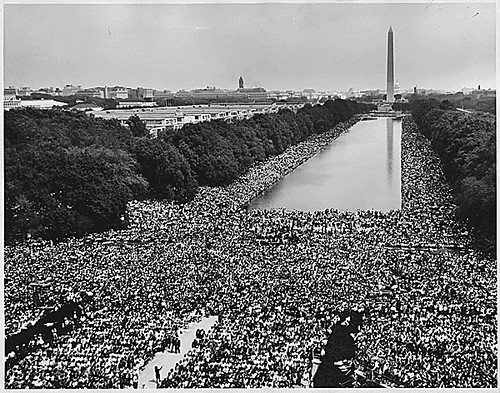
      This post may seem a little obvious with what tomorrow is, but I'm going to write on this subject anyway.  I admire Martin Luther King, Jr. for his stand against many of the United States.
      Even though nearly everyone knows his story, I'm just going to give a quick refresher.  At the time, there was major segregation between Blacks and Whites in the US.  The segregation went to far as to have Whites and Blacks separated into different schools and even to have different restrooms. Martin Luther King, Jr. took a stand against all this and most of the US (and by most, I don't mean all).  Martin Luther King, Jr. used non-violent protests to get a point across (which was partly inspired by Ghandi's way of protest).  He succeeded in changing the entirety of the US and how  people look at the small differences in each the other man.  In the end, as everyone knows, Martin Luther King, Jr. was assassinated.
      I admire Martin Luther King, Jr. for his capability to stand against such a large mass of people, something I don't think I could ever replicate.  Martin Luther King, Jr.'s peaceful protest inspires me to do the same with conflict among others.  Even in the face of danger and death, he did not use violence, something that inspires this non-violent method even more.  Martin Luther King, Jr. had everything to lose, his home, family, and even his life, and yet he still stood up for what he believed in.
      Against all odds, Martin Luther King, Jr. stood up for what he thought was right and I admire him immensely for that.

Image from 
http://images.google.com/imgres?imgurl=http://farm1.static.flickr.com/113/286476887_d43f3cff29.jpg&imgrefurl=http://www.knowmoremedia.com/influences/&usg=__6wugj_gkpccYJVzolyfCpqaGVgQ=&h=393&w=500&sz=140&hl=en&start=9&sig2=xjWTweVENKcCT7LltjntUw&um=1&tbnid=5u1k79LU752-WM:&tbnh=102&tbnw=130&prev=/images%3Fq%3Dmartin%2Bluther%2Bking,%2Bjr.%2Bmarch%2Bon%2Bwashington%26hl%3Den%26safe%3Doff%26um%3D1&ei=fMhTS5XQEJLytQOIu43hBw

Thursday, January 14, 2010

Something I wish I could change, but really can't

Less homework.  I really am just writing about this because I don't want to get into politics or war.  Homework can be a major dampener on study time and free time.  I believe that if you are really taught what you are supposed to be taught at school, you should not need to learn more at home on your own time.  I believe that time at home should be used to study or relax.

Monday, January 11, 2010

Taking a Stand

     Many people may think that taking a stand for what they believe in is difficult.  Taking a stand can be very difficult, if you make it difficult for yourself.  I took a stand for what I believed in.  This was no small task for me.
     First, a little background info.  I moved into a new house about a year ago.  This new house is actually a warehouse and it wasn't exactly in the best condition when we moved in.  Ever since, my family and I have been working on our new home.  Everyone does their part, some more than others, but it is still help none the less.  My Father is home nearly all the time and he does about  90% of everything that gets done around the house.  My Mother helps all she can, though she has a day job and isn't home nearly as much as my Father.
      This is where explaining gets difficult.  My Father doesn't exactly have a day job he goes to every morning at 8 but still gets payed even though he is home most of the time (and I don't mean he has a job on the computer at home or anything).  My Mother does and usually gets home around 5.  Honestly and bluntly, my Mother complains of (nearly) all that my Father does even when he does his best and just does what's best for us.
      Back to what I've been meaning to say from the start, taking the stand.  At the time, I was playing at the computer when my Mother and someone she was talking to walking into the room a couple steps away.  My Mother said something to the effect (that's probably the wrong a/effect) of complaining about the trimming near a door being off the ground.  The person she was talking to agreed and said that they had suggested the same.
     I couldn't take it anymore.  I stood up and walked over to my mother.  I explained to her that my Father does much more for us than she knows and that he does what he does because he loves us.  I didn't wait for a response as I turned back to the computer.
     Some teenagers may have little to no respect for their parents and think that this stand is nothing compared to what they do.  I respect my parents very much which made this stand that much harder for me.

Wednesday, December 16, 2009

Book Review: 1984

George Orwell's 1984 amazed me with the style of writing and Orwell's concept of a future dystopia.
1984 is told through a third person point of view, with a little twist. Most of the actions throughout the story are told in the normal third person view, or the one most people are used to. The twist comes when the reader sees and hears into the mind of the main character, Winston. In the world of 1984, fear is the main way that the government controls its members. This is known better when you see into Winston's mind and can feel his fear. Winston's fear cuts deeper when he is faced with death and his most feared figure in his life.
Even though the year 1984 has passed, George Orwell's concept of a future dystopia seems to grow ever more possible in our world. Orwell's dystopian government is ruled by fear, torture, false accusations, self-destruction, lies, oppression, poverty, deception, and a form of mass hypnosis. If someone were to compare what seems to be our government's direction that we're beginning to take, they could begin to pick out some similarities. The government of 1984 is one of blind devotion and the consequence for being too smart or mutinous is simply death.
I would recommend 1984 to anyone who like an "Alternate Future" kind of book. The story does get more and more depressing the more one thinks about the subject though. The government of 1984 may seem closer than someone may think.

Monday, December 14, 2009

Book Review: Julius Caesar

Shakespeare's Julius Caesar challenged me with its moderately complex text and kept my thoughts of irrational behavior in check with the results of the actions taken.
Julius Caesar was written in the year 1599 by William Shakespeare. Since this novel was written a little over 400 years ago, finding the text complex in our time is easily understood. However, attempting to just read through the novel without looking at the side notes can make someone misunderstand the plot or get lost in translation. The side notes (or foot notes, I'm not really sure which one is the correct term because the notes are on the page next to the play's text but that's just me rambling) help immensely in understanding what is happening in the play and give a little insight as to what people of the time referred to. Reading the side notes is a trade off between understanding the story and the time needed to read the novel though I prefer to understand what I'm reading.
The decision to kill Caesar is justified by Brutus to be for the good of the people and is made in haste. This irrational decision has both its short and long term results on the conspirators and all the people of Rome. At first, the conspirators celebrated the assassination of Caesar in seeing that his death was the end of the beginning of an empire. In the long run, the conspirators must face the consequences for their irrational behavior. These actions and consequences in the novel make me question my own thoughts when I think irrationally and help me to think more clearly. Even though the gravity of the situation in the novel and in my own mind are quite different, I still find the story to teach me of my own behavior and its consequences.
Julius Caesar is a very good novel, despite its age and somewhat alien references. I would recommend this book to anyone interested in the times of Julius Caesar or his assassination. I would recommend this book only if one is willing to read the side notes though, because the dialogue makes much more sense with them.

Sunday, December 13, 2009

What Makes a Leader a True Leader?

     You may know many leaders, from the ones known by everyone to the ones only you know of.  The question is, what makes a leader a true leader?  This subject is easily debatable so keep in mind that this is my opinion and yours may differ, and that's fine.  One of the first characteristics of a leader that comes into my mind is charisma.  Dictionary.com defines charisma as "a spiritual power or personal quality that gives and individual an influence or authority over large numbers of people".  Being a natural leader helps in many ways.  Another characteristic of a true leader, I think, is being willing to lead in your endeavors.  A leader sitting in the rear of the action isn't really a true leader if he doesn't stand up himself for what he wants is he?  A true leader must inspire the people he leads, if he doesn't, the people he leads are just blind followers.
           -This blog post is for a class I barely care for at the moment, so it isn't the best I can muster